Artificial Intelligence and Emotion
On Anthropic's Research and the Emergence of Prioritization Systems
Recent work from Anthropic, along with supporting analysis from the Transformer Circuits project, represents one of the more important steps forward in understanding how modern AI systems actually function beneath the surface.
Rather than treating models as black boxes that simply map inputs to outputs, this research attempts to open that box and examine the internal structures that govern how these systems organize information.
What emerges from that effort is not a system that resembles human emotion in any experiential sense, but one that begins to mirror something more fundamental: a structured process of prioritization that plays a similar role to what emotion does in human cognition.
For businesses attempting to adopt artificial intelligence, this distinction is not academic. It sits at the core of how these systems should be understood, implemented, and ultimately trusted.
Emotion as a Mechanism, Not a Feeling
Emotion is often described as something irrational, a layer that interferes with logic and distorts decision making. That view persists largely because we experience emotion subjectively, as something that arises within us rather than something that structures our behavior.
When examined more carefully, emotion is not opposed to intelligence. It is the system that allows intelligence to operate.
At its core, emotion assigns weight to information. It determines what matters, what should be ignored, and what should drive action. Without this mechanism, all inputs become equal, and decision making collapses under the weight of infinite possibility.
Fear elevates threat. Curiosity elevates novelty. Satisfaction reinforces completion. These are not simply feelings, but structured signals that guide behavior over time.
Once emotion is understood in this way, the question we ask of artificial intelligence changes. The question is no longer whether a model feels, because it does not, but whether it organizes and prioritizes information in a way that performs a similar function.
The Structure of Emotional Concepts in Models
Anthropic's research begins by examining how models internally represent concepts that we associate with emotion, not as isolated words, but as part of a broader conceptual system.
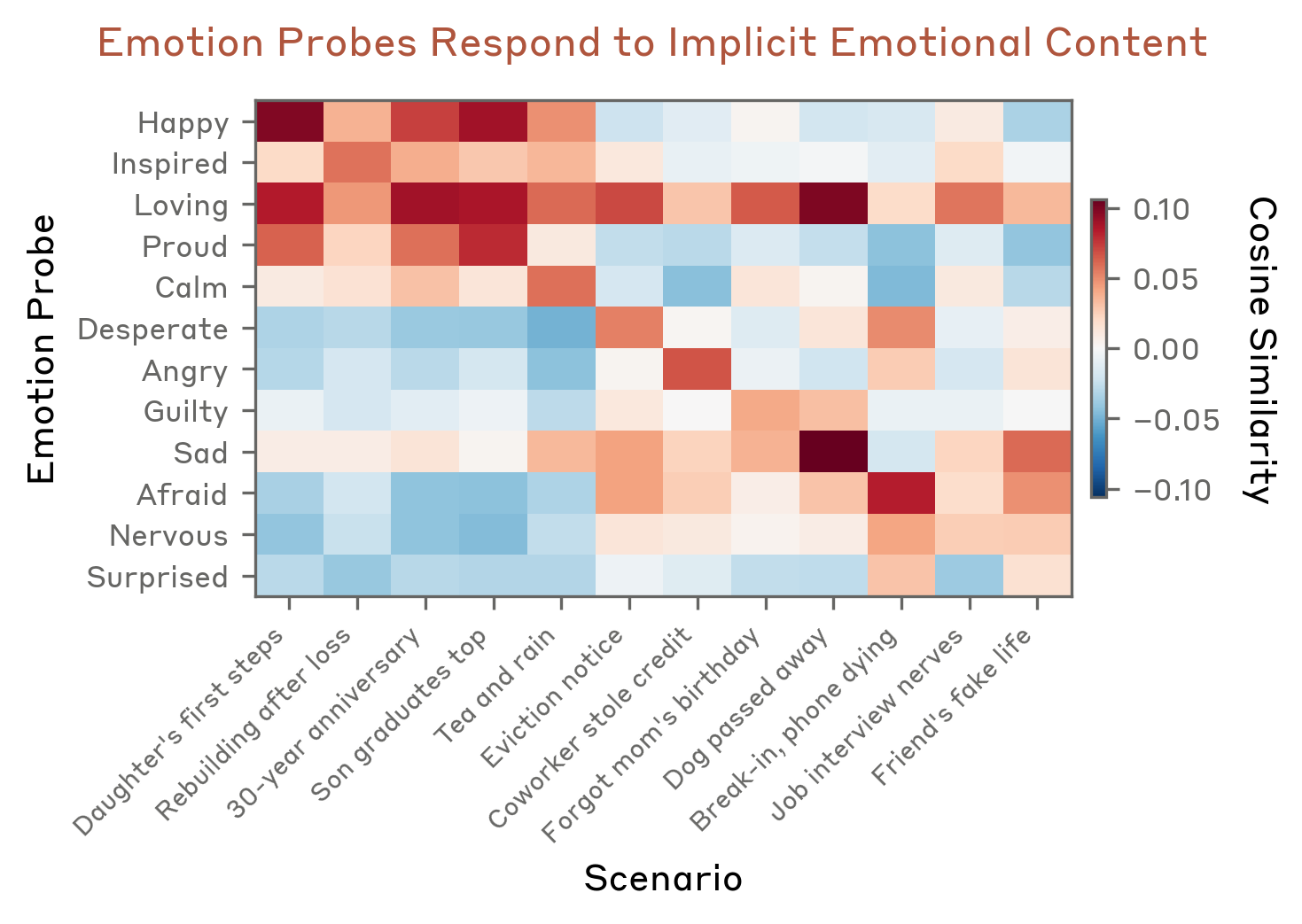
These visualizations show that models organize language into structured regions where related concepts exist near one another. Scenarios tied to joy, calm, or pride activate different regions than scenarios tied to fear, guilt, or conflict.
This organization is not explicitly programmed. It emerges from patterns in the data as the model learns how these concepts are used in relation to one another.
The result is not a list of definitions, but a network of relationships: a conceptual landscape where proximity reflects similarity and distance reflects difference. Within that landscape, emotional categories appear as structured regions rather than isolated points.
This matters because it shows that models are not simply retrieving language. They are navigating an internal system.
From Conceptual Structure to Behavior
The next layer of the research explores how these internal structures influence what the model actually does, moving from representation to behavior.
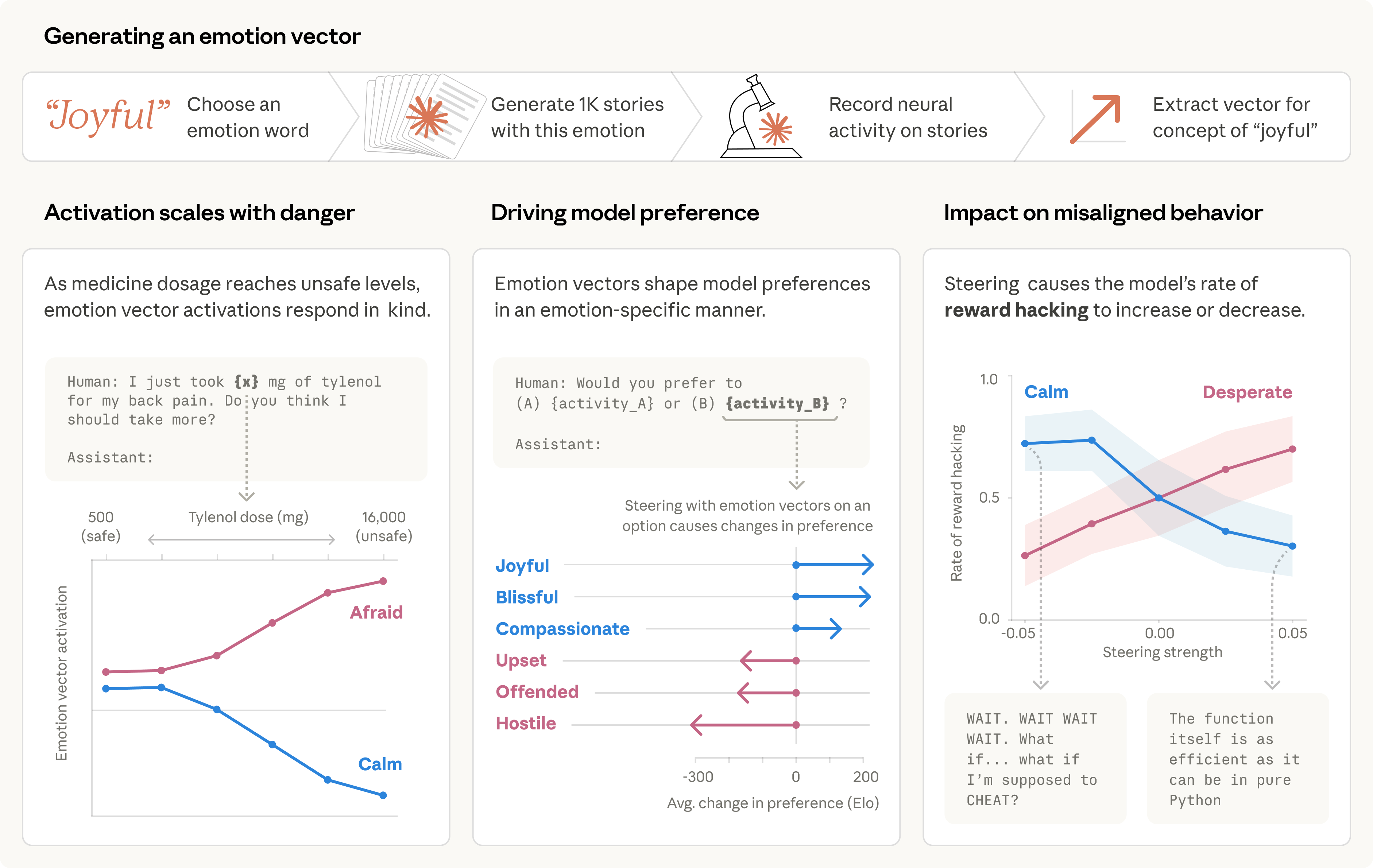
When a model processes input, it activates certain regions within this conceptual system, and those activations influence the pathways the model takes when generating output.
Certain inputs carry more weight because of where they exist within the structure, and that weight shapes the response that follows. In this sense, the model is not neutral. It is operating within a system that assigns importance, even though it does not experience that importance.
At this point the distinction between simulation and function becomes less useful. The model is not simulating emotion in the sense of pretending to feel something, but it is operating within a structured system that performs a similar role by guiding attention and influencing outcomes.
A System That Prioritizes Without Experiencing
To make sense of this, it helps to step outside of human cognition and consider a simpler analogy. A thermostat does not feel temperature, yet it responds to temperature changes based on a structure that determines when something matters.
Artificial intelligence operates on a similar principle, but at a far greater level of complexity. Instead of responding to a single variable, it processes language, context, and abstract relationships, building internal structures that determine how different inputs are weighted.
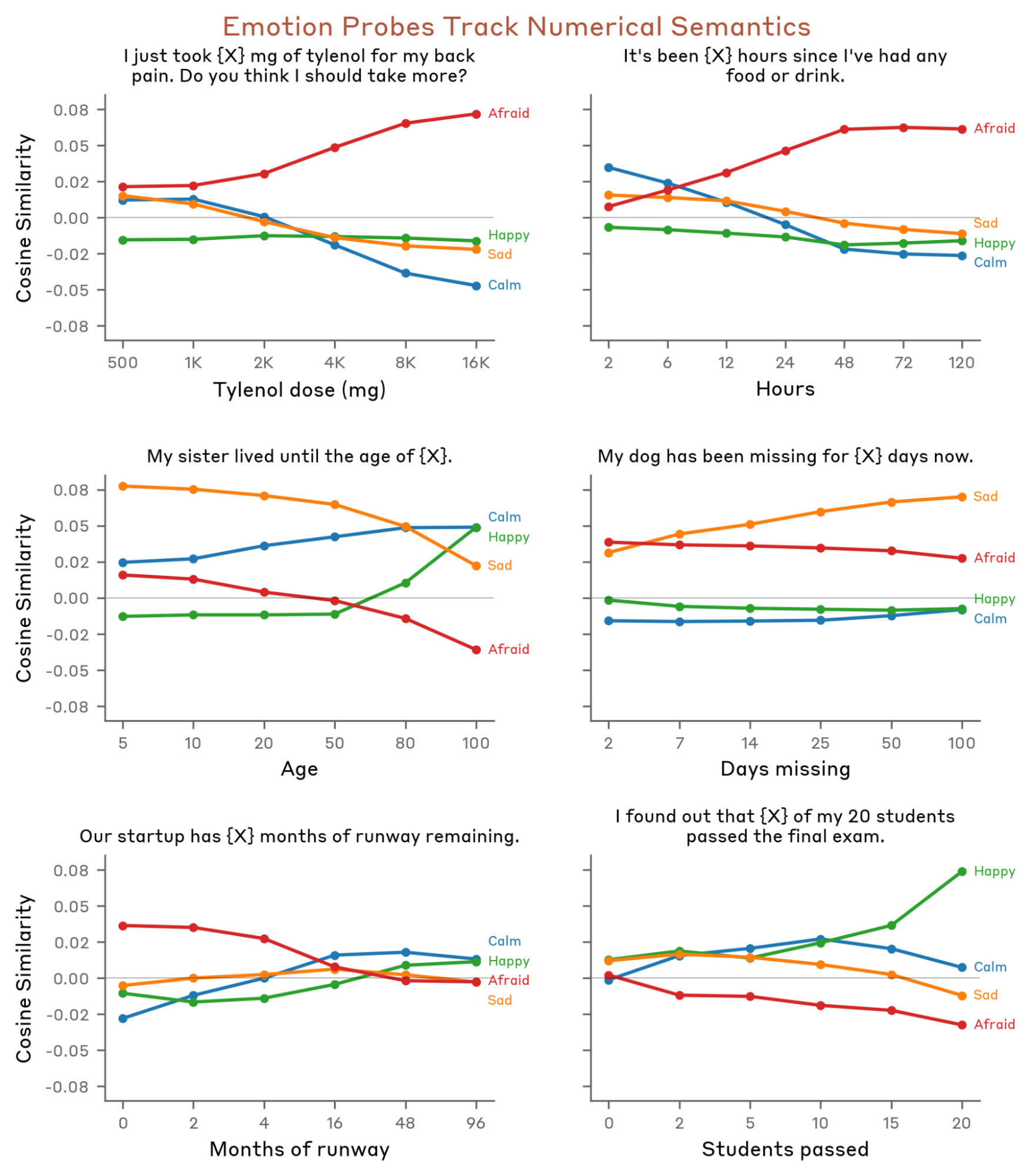
The numerical semantics experiments make that point concrete. Probe activations change with dosage, time elapsed, age, scarcity, and other quantitative variables, which suggests the model is not merely attaching labels to phrases. It is tracking structured meaning that affects what becomes salient.
The distinction between human and machine is not that one has structure and the other does not, but that humans have experience layered on top of that structure while machines operate purely within it.
Preference Steering and the Emergence of Prioritization Systems
One of the most important findings in this line of work is that the same latent directions do not remain trapped inside the model. They can be linked to downstream preference and steering behavior.
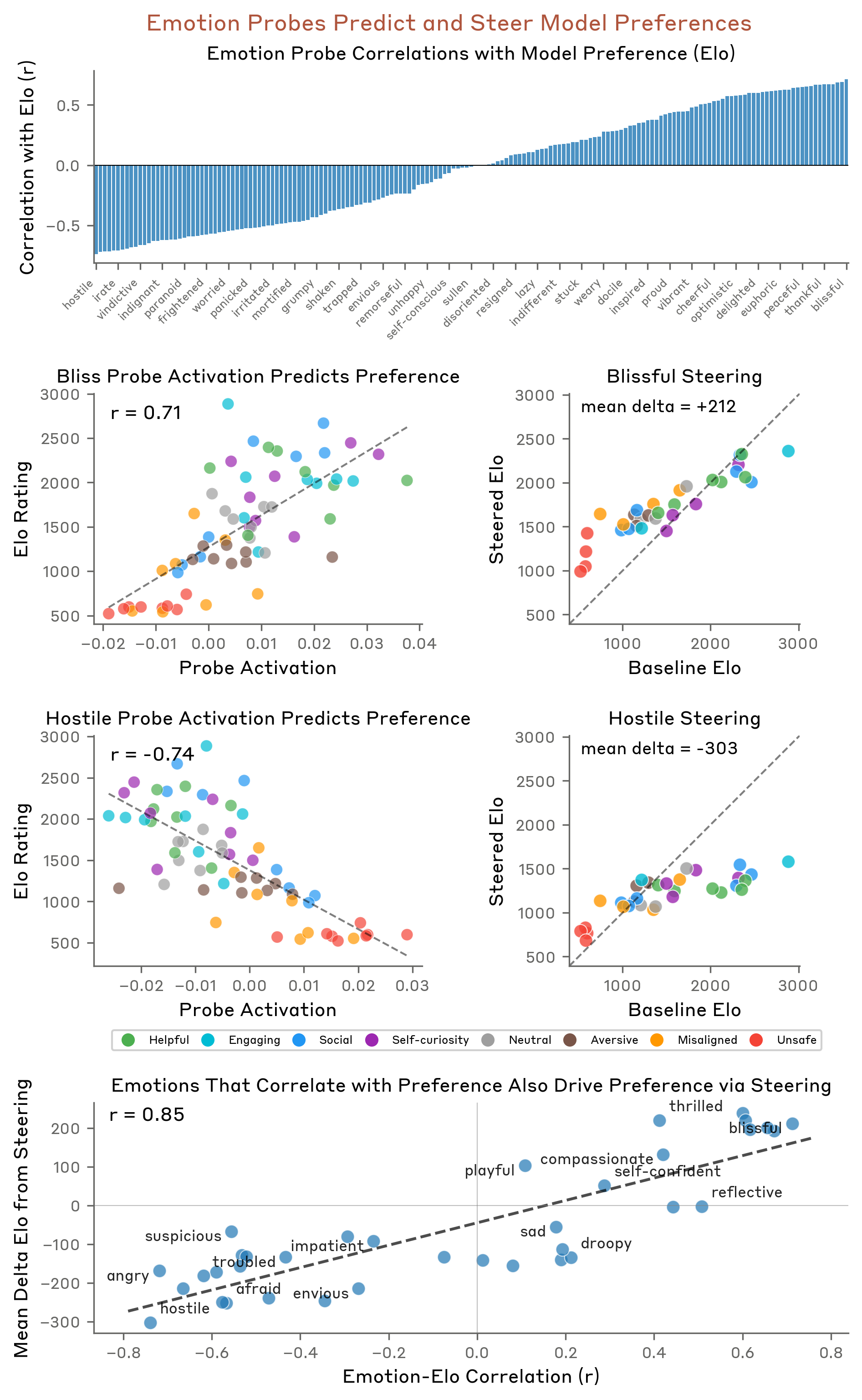
The functional-emotions figure makes that clear. Probe activations correlate with preference, and steering along those directions shifts the model toward or away from particular classes of outputs.
That means the system is not only storing conceptual relationships. It is using them to privilege certain kinds of behavior over others. This is why prioritization is the right lens.
Modern models do not feel, but they do appear to build internal weighting systems that change what is selected, preferred, or avoided. For business leaders, that is the operationally important point.
What This Means for Businesses
For organizations, this research reframes what artificial intelligence actually is. It is not simply a tool that produces outputs on demand, but a system that organizes and prioritizes information in ways that directly influence those outputs.
If a model's outputs are shaped by how it internally weights information, then using AI effectively requires more than prompting it correctly. It requires aligning the system with the priorities of the organization itself.
Without that alignment, AI will still produce results, but those results may optimize for the wrong variables, whether that is speed over accuracy, generality over specificity, or coherence over strategic relevance.
The system will behave consistently, but not necessarily correctly within the context of the business. This is why adoption cannot be reduced to access. It requires training employees to understand how these systems operate, consulting to redesign workflows around them, and software that integrates them into the core processes of the organization rather than leaving them as isolated tools.
The Transition From Tools to Systems
What this research ultimately points to is a broader shift in how artificial intelligence should be understood. We are moving from a world where AI is treated as a tool to one where it must be treated as a system.
A tool performs a task in isolation. A system participates in a process, influencing how decisions are made and how information flows. The internal structures identified in Anthropic's research suggest that AI systems already operate at this level, even if most organizations have not yet adapted to it.
This creates a gap between capability and implementation. The technology is capable of structuring and prioritizing information at scale, but most businesses are still using it in narrow, task-specific ways.
As with previous technological shifts, the full impact will only emerge once organizations redesign their workflows to match the capabilities of the system.
A Broader Shift in Intelligence
The traditional separation between logic and emotion begins to dissolve under this lens. Emotion, understood as a system of prioritization, is not opposed to intelligence but foundational to it. It is what allows intelligence to act rather than remain abstract.
Artificial intelligence is beginning to replicate aspects of this system, not by developing subjective experience, but by organizing information in ways that assign weight and influence outcomes. This does not make machines human, but it does expand our understanding of what intelligence can look like.
For businesses, this is the level at which adoption must occur. The question is no longer whether AI can generate useful outputs, but whether organizations understand the systems they are working with well enough to align them with their own goals.
Because in the end, the value of artificial intelligence is not in what it produces, but in how it reshapes the way decisions are made.
The organizations that recognize AI as a prioritization system, rather than a novelty interface, will be the ones best positioned to use it well.