Artificial Intelligence and the Labor Market
What Businesses Should Learn From Anthropic's Data
Artificial intelligence is often discussed through extremes. Some claim it will eliminate entire professions while others believe it will simply become another productivity tool like the spreadsheet or the internet.
The reality is more complex.
A recent research paper from Anthropic provides one of the clearest early looks at how artificial intelligence is actually interacting with the labor market. Rather than speculating about what AI might be capable of doing in the future, the researchers analyzed how people are already using AI systems in real work environments.
The findings reveal something important for businesses.
AI is already affecting work. But the largest barrier is not the technology itself. It is adoption.
For companies, this creates both a risk and an opportunity. Organizations that fail to integrate AI into their workflows will fall behind competitors who learn how to use it effectively.
Companies that successfully adopt AI will dramatically increase productivity.
Where AI Is Already Transforming Work
The first chart below shows the occupations with the highest observed exposure to artificial intelligence based on real usage data.
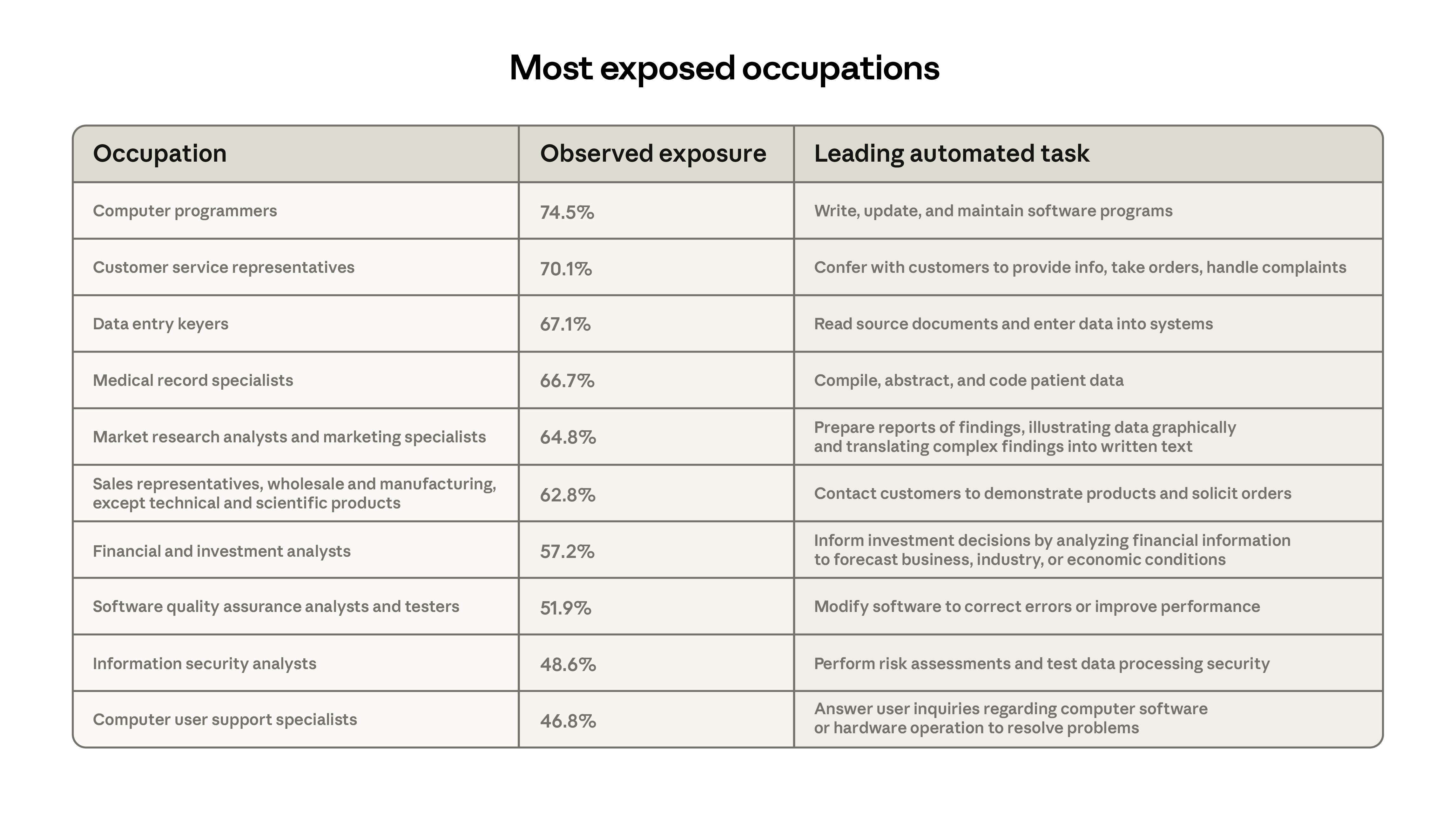
Several trends stand out immediately.
Knowledge-based digital roles appear most exposed to AI automation. Software development, customer service support, data entry, research analysis, and financial analysis all show high levels of interaction with AI tools.
These roles share a common characteristic. Much of their work involves processing information, writing, summarizing, or interpreting data. These are exactly the types of tasks modern language models perform well.
However exposure does not mean replacement.
Instead AI is increasingly performing portions of tasks within these roles. A programmer might generate boilerplate code with AI. A market researcher may use AI to summarize datasets. Customer service teams might draft responses with AI before reviewing them.
The role remains human. The workflow changes.
For organizations this means productivity can increase significantly when employees understand how to work with AI tools effectively.
This is where training and implementation strategy become critical.
The Gap Between Capability and Real Usage
The next visualization highlights a key insight from the research.
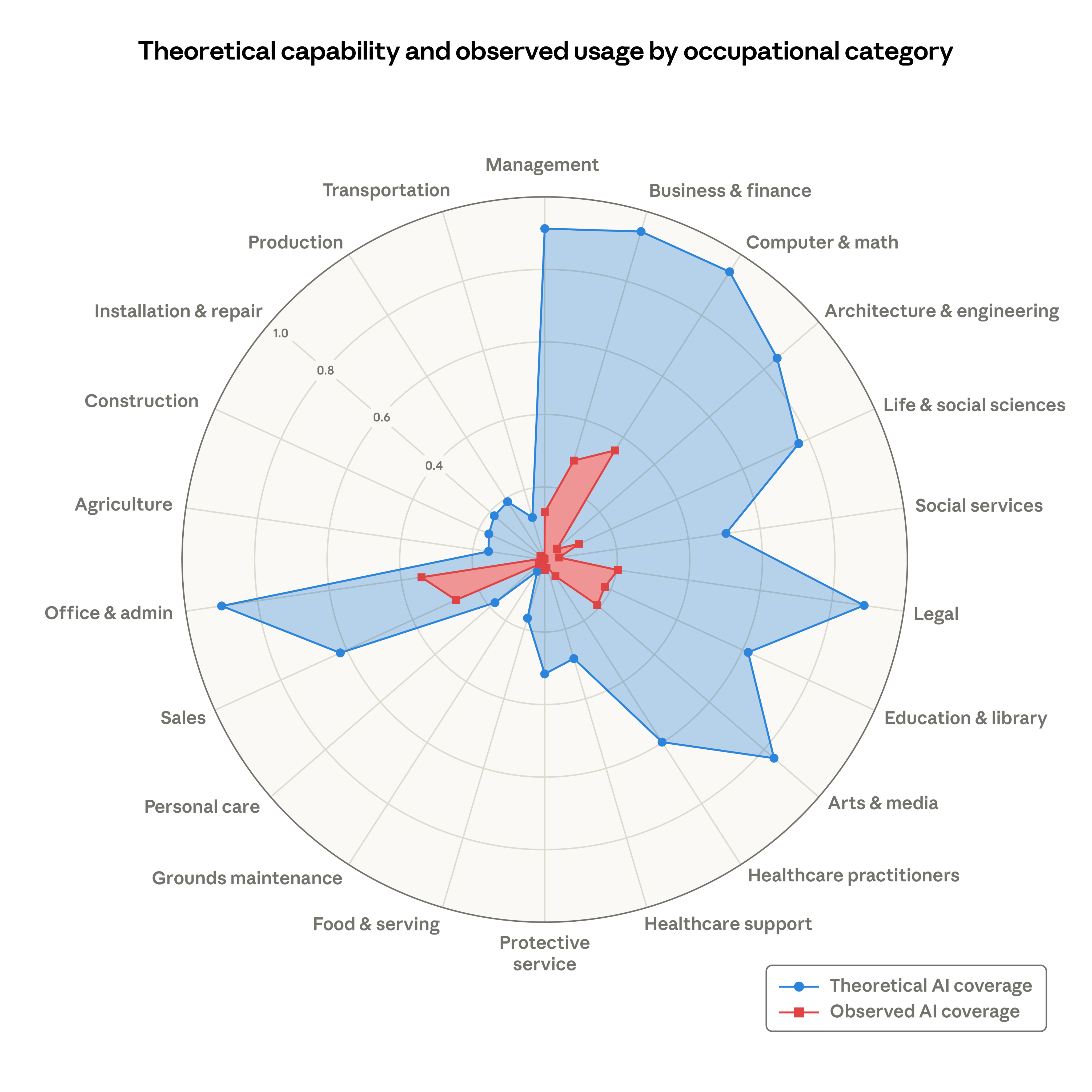
The blue area represents the theoretical capability of AI across different job categories. The red area represents actual usage.
The gap between them is enormous.
Artificial intelligence could theoretically assist with a large percentage of work across business, finance, computer science, law, marketing, and media. Yet real adoption remains far lower.
This gap is one of the most important signals in the entire study.
The technology already exists. What is missing is implementation.
Most organizations have not yet redesigned workflows, trained employees, or integrated AI tools into daily operations. As a result, companies are capturing only a fraction of the productivity gains AI could deliver.
This is the stage of every major technological shift.
When electricity was first introduced, factories initially used it to power the same machines previously driven by steam. It took years before organizations redesigned factories around the capabilities of electric motors.
Artificial intelligence is now entering a similar phase.
Companies that learn how to integrate AI into workflows will capture the greatest gains.
Early Signals in the Labor Market
The final chart examines the relationship between job growth and AI exposure.
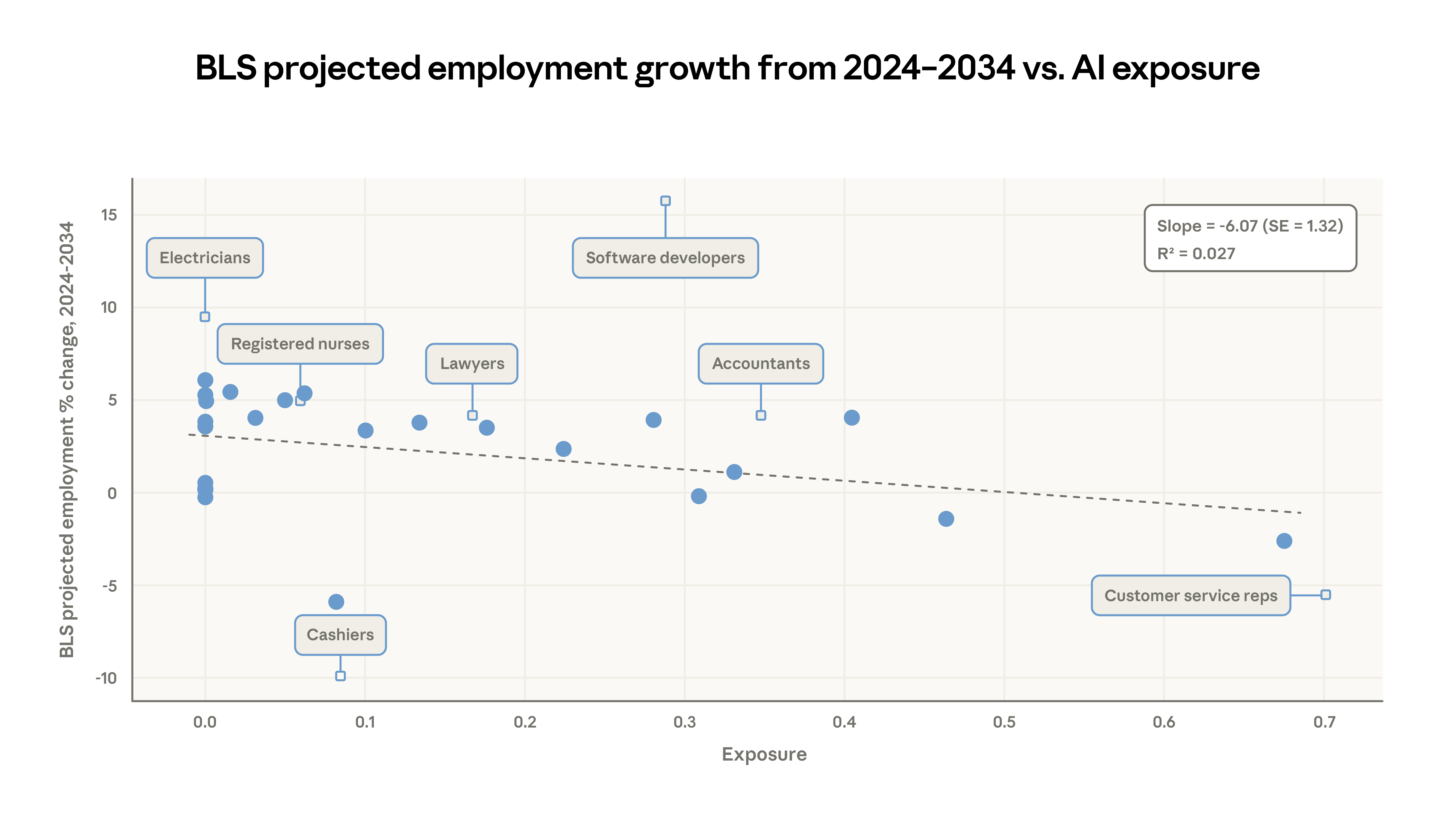
The data suggests an emerging pattern.
Roles with higher AI exposure are beginning to see slower employment growth. Customer service roles appear particularly affected, while some technical fields like software development remain strong due to continued demand.
This does not necessarily indicate widespread job loss. Instead it reflects a familiar pattern in technological transitions.
New tools increase productivity before they reduce workforce size.
Organizations adopt the technology, employees become more efficient, and hiring slows as each worker produces more output.
For business leaders this highlights an important point.
Artificial intelligence is not simply an automation technology. It is a productivity multiplier.
Why AI Adoption Is a Strategic Imperative
The most important takeaway from this research is not that AI will eliminate jobs.
It is that companies who learn to use AI effectively will outperform those who do not.
Organizations face three immediate challenges when adopting artificial intelligence:
First, employees often lack training on how to use AI tools productively.
Second, companies rarely have structured workflows that incorporate AI systems into existing processes.
Third, many organizations experiment with AI informally rather than implementing it strategically.
This creates a large gap between potential productivity and real productivity.
Closing that gap requires structured adoption.
That includes employee training programs, consulting on AI workflow design, and the development of software systems that integrate AI directly into business operations.
Companies that invest in these capabilities today will define the next generation of productivity.
The Organizations That Move First
The Anthropic research shows that we are still early in the adoption cycle of artificial intelligence.
The technology is advancing quickly, but most organizations are still experimenting rather than transforming their operations.
This creates a rare moment in technological history.
Companies that adopt AI strategically today can achieve productivity gains that were impossible only a few years ago.
Those who wait may find themselves competing against organizations that have already redesigned how work gets done.
Artificial intelligence is not simply another tool. It is a new layer of capability within modern businesses.
The question is no longer whether companies will adopt AI.
The question is how quickly they learn to use it.
Source: Anthropic labor market research