Rethinking Context Through Subquadratic Attention
Why Long Context Matters
One of the biggest limitations in modern AI is not intelligence itself, it is memory.
Current models are incredibly capable in isolated environments. They can write code, summarize research papers, generate reports, and answer complex questions. But once the amount of information grows large enough, most systems begin to break down. They lose track of relationships between ideas, miss relevant information buried deep in context windows, and become increasingly expensive to run as more data is added.
This becomes obvious when AI moves from demos into real environments.
A business is not a single prompt. A codebase is not a prompt. A legal archive is not a prompt. Real systems are massive webs of interconnected information spread across documents, repositories, databases, communication logs, APIs, and operational history. Useful intelligence depends on being able to move through all of that information coherently.
That is where long context becomes important.
Why Long Context Breaks Today
Most transformer architectures today use what is called quadratic attention. In simple terms, every token compares itself against every other token in the context window. This works well at smaller scales, but as context increases the computational requirements rise dramatically.
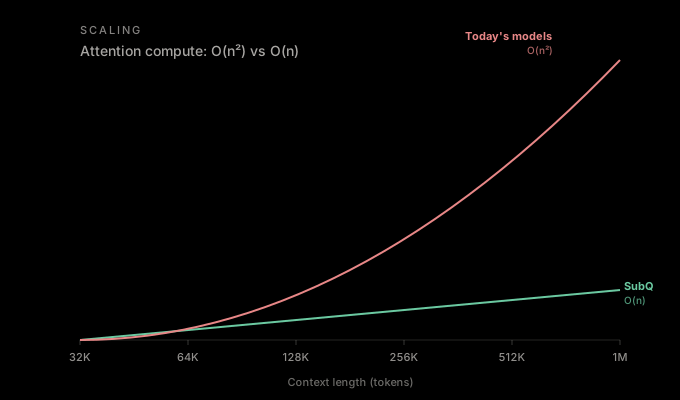
This is why many long-context models struggle in practice.
A model may technically support a million-token context window, but maintaining reasoning quality across that entire space is much harder than simply loading the tokens into memory. As context expands, retrieval quality weakens, important information gets diluted, latency increases, and inference costs become difficult to manage.
Bigger context windows alone are not useful if retrieval quality collapses as the system scales. The challenge is not just how much information fits into the window. It is whether the model can still reason coherently across that information once it is there.
How SSA Changes the Problem
SubQ’s Subquadratic Sparse Attention architecture, or SSA, is attempting to solve this problem differently. Instead of treating every token interaction equally, SSA selectively routes attention toward the most relevant information within the context window.
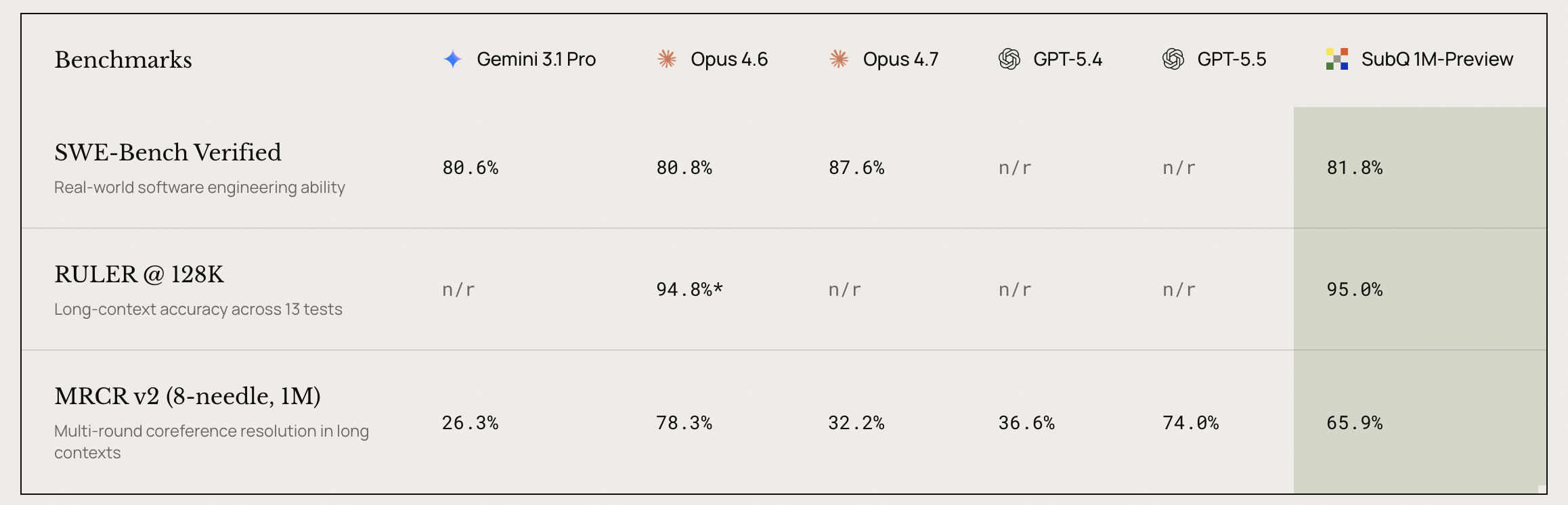
That may sound like a small architectural change, but it fundamentally changes how AI systems scale.
Human beings do not process every piece of information equally at all times. When reading a book or solving a problem, attention naturally shifts toward what appears most relevant while still maintaining awareness of the broader context. Dense transformer architectures attempt to process everything simultaneously, which becomes increasingly inefficient as information grows.
SSA approaches context more like prioritization than brute force computation.
According to SubQ’s published research, the architecture is designed to maintain coherent reasoning across context windows reaching up to 12 million tokens while significantly reducing the computational burden associated with dense attention models.
Retrieval Is Becoming the Core Problem
What makes this interesting is not simply the number itself. Bigger context windows alone are not useful if retrieval quality collapses as the system scales. The more important part of SubQ’s benchmarks is the focus on maintaining retrieval consistency and reasoning performance at extended context lengths.
That distinction matters because retrieval is becoming the core problem in AI.
Most enterprise systems already contain the information needed to answer questions or complete tasks. The issue is locating the correct information across fragmented systems and maintaining relationships between distant pieces of context. This is where many current AI systems fail. Not because they cannot generate text, but because they cannot reliably reason across large informational environments.
The practical challenge is no longer generating information. It is maintaining relevance across massive informational surfaces while remaining computationally efficient enough to use in production.
That is why architectures like SSA matter.
Why This Matters for Software Engineering
This becomes especially important in software engineering.
Large repositories can contain millions of lines of code spread across thousands of files. Dependencies, APIs, architectural decisions, implementation history, and internal documentation all exist across different layers of the system. Existing AI models often struggle in these environments because they lose coherence across the broader structure of the repository.
Long-context reasoning changes that dynamic entirely.
Instead of interacting with isolated snippets of code, AI systems begin operating against the repository as a complete environment. The same applies to research systems, legal analysis, financial infrastructure, and enterprise operations.
Why This Matters for Enterprise AI
Most businesses are currently dealing with the same problem: they are drowning in information while struggling to extract operational intelligence from it.
Internal documentation exists in one system. Customer conversations exist somewhere else. Engineering knowledge lives inside repositories and Slack channels. Legal records, contracts, operational procedures, and analytics are all fragmented across different environments.
Current AI systems can assist with pieces of that information, but they often fail when asked to reason across the full system simultaneously.
This is where long-context architectures become commercially important.
If AI can maintain coherence across large informational environments, businesses no longer need to constantly compress, summarize, and restructure their data for models to use it effectively. The system itself becomes capable of navigating institutional knowledge directly.
That has implications across nearly every industry.
In software engineering, long-context reasoning allows models to understand entire repositories instead of isolated files. This improves consistency, reduces hallucinated implementations, and creates more useful AI-assisted development workflows.
In legal and compliance environments, AI systems gain the ability to reason across years of contracts, regulations, and discovery documents while maintaining contextual relationships between them.
In enterprise operations, long-context systems can function more like an organizational memory layer rather than a chatbot attached to a search engine.
Persistent AI agents also become far more realistic under architectures like SSA. Current systems often feel stateless because maintaining large contextual histories becomes computationally expensive very quickly. More efficient attention allocation changes the economics of persistent reasoning systems entirely.
The Next Phase of Progress
This may ultimately become one of the most important transitions happening in AI right now.
For the past several years, the industry has largely advanced through brute force scaling. Larger models, larger training runs, and larger compute clusters drove most improvements. But long-context workloads expose the limitations of scaling dense attention indefinitely.
Architectural efficiency is becoming just as important as raw scale.
SubQ’s research reflects a broader shift beginning to emerge across AI infrastructure. The next phase of progress may not simply come from building larger models. It may come from building systems that allocate intelligence more efficiently across increasingly large environments.
Because at enterprise scale, the problem is no longer generating answers.
The problem is understanding systems.
Source: SubQ SSA research